
IRS & STATE PENALTY RELIEF
TAX PENALTY ABATEMENT
Tax penalties can add significantly to the amount you owe. Depending on the type of penalty and your circumstances, you may qualify to have certain penalties reduced or removed. Switchback Accounting can evaluate your eligibility for penalty abatement and represent you before the IRS or state taxing authority.
WHAT IS TAX PENALTY ABATEMENT?
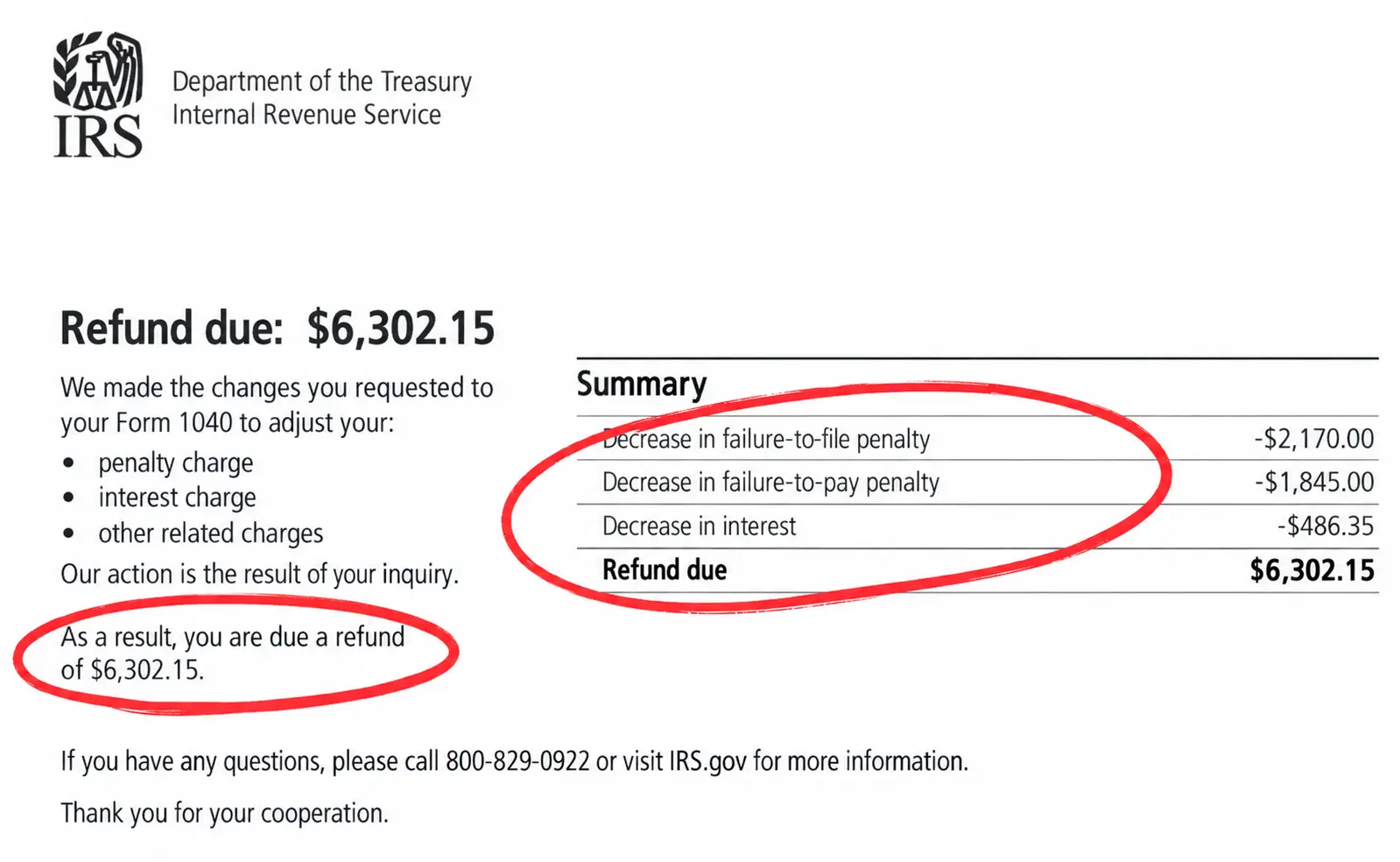
Tax penalty abatement is the reduction or removal of certain penalties assessed by the IRS or a state taxing authority. Penalties can arise from filing or paying late, failing to make required tax deposits, and other compliance issues.
Whether a penalty can be removed depends on the type of penalty, the tax period, your compliance history, and the circumstances that caused the problem. At the federal level, relief may be available through administrative relief, reasonable cause, or a statutory exception. State tax agencies have their own rules and procedures for granting penalty relief.
One important current wrinkle: the IRS began transitioning in 2026 from First Time Abate to its new Automatic Exemption from Penalty (AEP) program. So farther down the page we’ll explain both rather than publishing outdated language that treats First Time Abate as the only current administrative option.
WAYS TAX PENALTIES MAY BE REDUCED OR REMOVED
There is more than one basis for obtaining penalty relief. The appropriate approach depends on the taxing authority, the type of penalty, your compliance history, and the facts surrounding the failure.
ADMINISTRATIVE PENALTY RELIEF
Some penalties may qualify for administrative relief based on a taxpayer’s compliance history and other eligibility requirements. IRS procedures for this type of relief have changed in 2026, so eligibility depends in part on the applicable tax period and current IRS rules.
REASONABLE CAUSE
Penalties may be removed when the facts show that you exercised ordinary business care and prudence but were nevertheless unable to comply. The IRS considers the specific circumstances and supporting documentation when evaluating reasonable cause.
STATE PENALTY ABATEMENT
State taxing authorities may also provide penalty relief, but eligibility standards and procedures vary by state. We evaluate the rules that apply to the particular state, penalty, and circumstances involved.
AUTOMATIC PENALTY RELIEF & FIRST TIME ABATE
The IRS is transitioning from its longstanding First Time Abate (FTA) program to a new program called Automatic Exemption from Penalty (AEP). Both are based largely on a taxpayer’s prior compliance history, but the way relief is provided is changing.
Under AEP, eligible taxpayers with a history of timely compliance can receive relief automatically from certain failure-to-file, failure-to-pay, and failure-to-deposit penalties. In general, eligibility requires timely filing and payment for the prior three years, or the prior 12 consecutive quarters for quarterly returns. When AEP applies, the IRS prevents the eligible penalty from being assessed during original return processing rather than requiring the taxpayer to request relief afterward.
First Time Abate is still available for certain earlier and transitional tax periods. For eligible original returns with due dates on or after January 1, 2027, AEP replaces FTA.
GOOD COMPLIANCE HISTORY → POSSIBLE ADMINISTRATIVE PENALTY RELIEF
REASONABLE CAUSE PENALTY RELIEF
Even when you do not qualify for administrative penalty relief, certain penalties may still be abated if you can establish reasonable cause. The IRS generally looks at whether you exercised ordinary business care and prudence but were nevertheless unable to meet your tax obligation.
Reasonable cause is based on the specific facts and circumstances. Depending on the penalty involved, relevant circumstances may include a serious illness or death, fire or natural disaster, inability to obtain necessary records, or other events that prevented timely compliance.
A strong reasonable cause request does more than explain what went wrong. It should establish what happened, when it happened, how it affected your ability to comply, what steps you took to address the problem, and how quickly you corrected the issue once you were able to do so.
DEATH, SERIOUS ILLNESS OR UNAVOIDABLE ABSENCE
A death, serious illness, or unavoidable absence involving the taxpayer or an immediate family member may support reasonable cause when it prevented timely compliance.
FIRE, CASUALTY OR NATURAL DISASTER
A fire, casualty, natural disaster, or other significant disturbance may establish reasonable cause depending on how it affected the taxpayer’s ability to comply.
INABILITY TO OBTAIN RECORDS
Relief may be available when necessary records could not be obtained despite reasonable efforts to secure the information needed to comply.
MISTAKE WAS MADE
A mistake alone generally isn’t enough, but the circumstances that caused the mistake can support reasonable cause when the taxpayer otherwise exercised ordinary business care and prudence.
RELIANCE ON ERRONEOUS ADVICE
Depending on the penalty and circumstances, reliance on erroneous professional or other advice may be relevant to a reasonable-cause determination.
RELIANCE ON IRS ADVICE
Penalty relief may be available when a taxpayer reasonably relied on erroneous written or oral advice provided by the IRS.
IGNORANCE OF THE TAX LAW
Lack of knowledge alone doesn’t automatically establish reasonable cause, but it may qualify when combined with facts showing a reasonable, good-faith effort to comply.
ORDINARY BUSINESS CARE & PRUDENCE
The central reasonable-cause standard is whether the taxpayer exercised ordinary business care and prudence but was nevertheless unable to meet the tax obligation.
UNDUE ECONOMIC HARDSHIP
In appropriate circumstances, severe financial hardship resulting from timely payment may be relevant when evaluating reasonable cause for a failure-to-pay penalty.
HOW WE REQUEST PENALTY ABATEMENT
A successful penalty abatement request starts with identifying the penalties involved and determining the strongest available basis for relief. We review your tax history, develop the supporting argument, and handle the request with the taxing authority.
1. REVIEW PENALTIES
We review your account and notices to identify the penalties assessed, the periods involved, and whether administrative relief, reasonable cause, or another basis for relief may apply.
2. DEVELOP ARGUMENT
We evaluate the facts and determine the strongest basis for requesting abatement, including the circumstances that caused the noncompliance and the steps taken to correct it.
3. DOCUMENT & SUBMIT REQUEST
We gather supporting documentation and present the penalty-abatement request through the appropriate procedure. Depending on the circumstances, an IRS request may be handled by phone, written statement, or IRS Form 843.
4. FOLLOW THROUGH
We monitor the request, respond to questions, and review the agency’s decision. If the IRS denies penalty relief, appeal rights may be available; the IRS says the deadline is generally 30 days from the rejection letter, although the particular letter controls.
WHAT HAPPENS TO INTEREST IF PENALTIES ARE ABATED?
Interest and penalties are treated differently. The IRS generally does not remove interest simply because there was reasonable cause for filing or paying late.
However, when the IRS reduces or removes a penalty, it will automatically reduce or remove the interest charged on that penalty. Interest charged on the underlying unpaid tax generally remains unless a separate legal basis for interest abatement applies.
WHAT IF A PENALTY ABATEMENT REQUEST IS DENIED?
A denial does not necessarily mean the penalty-abatement process is over. If the IRS denies a request for penalty relief, the denial letter may provide the right to request review by the IRS Independent Office of Appeals.
We review the IRS’s reasoning, determine whether the facts and supporting documentation warrant further challenge, and prepare the appropriate response or appeal when available. This may include strengthening the reasonable cause argument, providing additional documentation, or addressing issues raised in the IRS’s decision.
Appeal deadlines matter. For many penalty-abatement denials, the IRS states that taxpayers generally have 30 days from the date of the rejection letter to request an appeal, but the specific notice or letter should always be reviewed for the applicable deadline and instructions.
TAX PENALTY ABATEMENT FAQs
Can all tax penalties be abated?
No. Whether a penalty can be reduced or removed depends on the type of penalty, the taxing authority, the applicable rules, and the taxpayer’s circumstances. Some penalties may qualify for administrative relief, reasonable cause, or another specific basis for relief.
Do I have to pay the penalty before requesting abatement?
Not always. Many penalty-abatement requests can be made before the penalty is paid. The appropriate procedure depends on the penalty and circumstances, and some disputes may instead involve paying the penalty and pursuing a refund claim.
Can I get penalty abatement if I already have a payment plan?
Potentially, yes. An installment agreement and penalty abatement address different issues. Being on a payment plan does not by itself prevent you from requesting relief from qualifying penalties.
Depending on the value and equity of your assets, they may increase the amount the IRS expects you to offer. An Offer in Compromise may still be possible when you own assets, but your entire financial situation—including income, expenses, asset equity, and future ability to pay—must be evaluated.
Does penalty abatement remove interest as well?
If the IRS removes or reduces a penalty, the interest attributable to that penalty is generally adjusted as well. Interest on the underlying unpaid tax usually remains unless there is a separate basis for reducing or abating it.
Can state tax penalties be abated?
Often, yes. States have their own standards and procedures for penalty relief, which can differ from federal rules. We evaluate the requirements of the particular state taxing authority and the circumstances surrounding the penalty.