
URGENT TAX COLLECTION HELP
IRS & STATE TAX LEVY HELP
A tax levy can put your bank account, wages, or other property at risk. If you’ve received a levy notice—or a levy has already been issued—Switchback Accounting can evaluate the collection action, communicate with the taxing authority, and work to protect your assets while addressing the underlying tax debt.
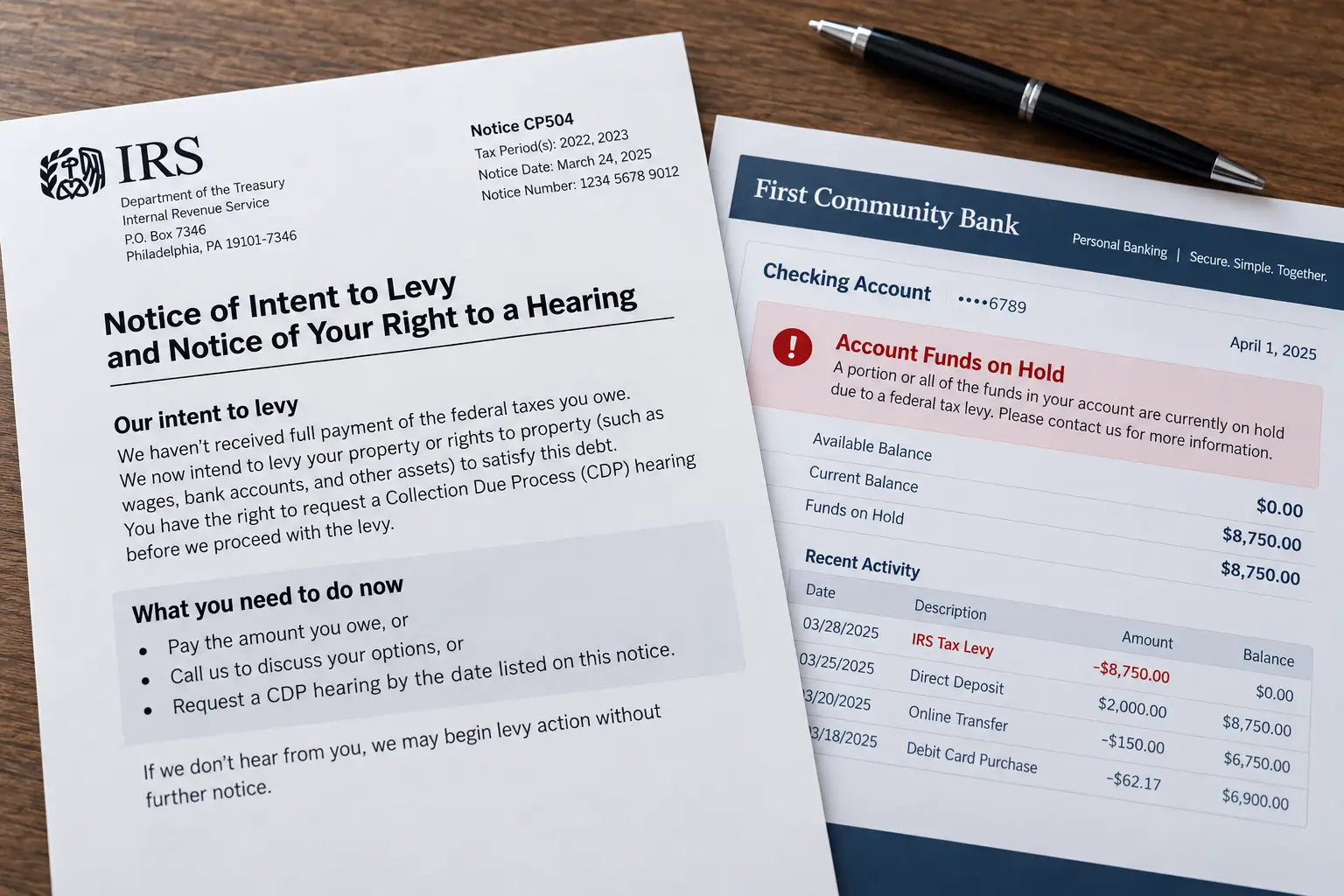
WHAT IS A TAX LEVY?
A tax levy is a collection action that allows a taxing authority to take money or property to satisfy an unpaid tax debt. An IRS levy can reach funds in a bank account, wages, certain business receivables, and other property or rights to property.
A levy is different from a tax lien. A tax lien is a legal claim against your property that protects the government’s interest in the debt. A tax levy actually takes money or property to collect it.
Common types of tax levies include bank account levies, wage levies or garnishments, levies on business receivables, and levies on other property or income.
WHAT HAPPENS WHEN A TAX LEVY IS ISSUED?
What happens after a levy is issued depends on the type of property being levied. Two of the most common collection actions involve bank accounts and wages.
BANK ACCOUNT LEVIES
When the IRS serves a levy on a bank, the bank generally freezes the funds in the account up to the amount of the levy. For an IRS bank levy, the bank generally holds those funds for 21 days before sending them to the IRS. This holding period can provide a limited window to address the levy before the funds are transferred.
WAGE LEVIES
A levy on wages works differently. Rather than taking funds only once, an IRS wage levy generally continues from paycheck to paycheck until the levy is released, the tax debt is satisfied, or the collection matter is otherwise resolved. A portion of the taxpayer’s wages is exempt from levy based on IRS rules.
RECEIVED A TAX LEVY NOTICE? TIMING MATTERS.
A levy notice should be addressed quickly. For most IRS levies, the IRS must provide a Final Notice of Intent to Levy and Notice of Your Right to a Hearing at least 30 days before the levy occurs.
Depending on the notice, you may have the right to request a Collection Due Process (CDP) hearing or pursue another resolution before the levy occurs. State procedures and deadlines vary.
ACT QUICKLY — YOUR RESPONSE DEADLINE MATTERS.
TAX LEVY HELP: CAN A LEVY BE RELEASED?
In some circumstances, a tax levy can be released. The appropriate approach depends on the taxing authority, your financial situation, the status of the collection case, and the underlying tax debt.
For IRS levies, release may be possible when the tax is paid, a payment arrangement is established, the levy creates economic hardship, or certain other legal requirements for release are met. Releasing a levy does not necessarily eliminate the tax debt, so the underlying collection problem still needs to be addressed.
HOW WE CAN HELP
1. Review Levy & Deadlines
Determine what action has been taken and whether important response or appeal rights remain.
2. Contact Tax Authority
Communicate with the IRS or state taxing authority regarding the levy and available options.
3. Address the Levy
Where appropriate, request release or other collection relief based on the circumstances.
4. Resolve the Tax Debt
Develop a longer-term resolution designed to address the liability and reduce the risk of future collection action.
RESOLVING THE TAX DEBT BEHIND THE LEVY
Getting a levy released may address the immediate collection problem, but the underlying tax debt still needs a resolution. Depending on your circumstances, options may include:
INSTALLMENT AGREEMENT
Pay the tax debt over time through an installment agreement based on the applicable IRS requirements and your circumstances.
OFFER IN COMPROMISE
For qualifying taxpayers, settle an IRS tax debt for less than the full amount owed.
CURRENTLY NOT COLLECTIBLE
If paying the IRS would prevent you from meeting necessary living expenses, collection may be temporarily suspended.
REAL RESULT: $50K+ TAX DEBT & BANK LEVY
A taxpayer came to Switchback Accounting facing more than $50,000 in IRS tax debt and a bank levy. After reviewing and correcting prior returns, the balance was reduced to below $45,000. We then secured an IRS installment agreement of approximately $670 per month and resolved the collection action, allowing the client to move forward with purchasing a home.
TAX LEVY FAQs
How long does an IRS bank levy last?
An IRS bank levy generally freezes the funds available when the bank receives the levy. The bank normally holds those funds for 21 days before sending them to the IRS, providing a limited period to resolve certain issues or obtain a levy release.
Does an IRS wage levy take my entire paycheck?
Not necessarily. A portion of wages is generally exempt from levy, with the exempt amount determined under IRS rules. Unlike a bank levy, a wage levy generally continues from paycheck to paycheck until it is released, the liability is paid, or another arrangement is made.
Can an IRS levy be released because of financial hardship?
Yes. If a levy prevents you from meeting basic, reasonable living expenses, economic hardship can be grounds for release. The IRS will generally require financial information to evaluate the situation.
Does releasing a levy eliminate the tax debt?
No. A levy release stops that collection action, but the underlying balance generally remains and still needs to be resolved.
What should I do if I receive a tax levy notice?
Review it promptly. The notice, taxing authority, and deadline determine what rights and resolution options may be available. For IRS matters, options may include an appeal or collection alternative such as a payment plan, Offer in Compromise, or Currently Not Collectible status.